

The Commander deck building checklist
A solid Commander deck usually starts with about 36 to 38 lands, 10 to 12 ramp pieces, 8 to 12 card draw or card advantage pieces, 8 to 12 targeted removal or interaction pieces, and 2 to 4 board wipes. From there, add protection, graveyard hate, recursion, win conditions, and the synergy cards that make your commander matter. These numbers are starting points, not laws, but they help prevent the most common Commander problem: a deck full of cool cards that cannot consistently cast spells, draw cards, answer threats, or close games.
- Lands — 36 to 38
- Ramp — 10 to 12
- Card draw / card advantage — 8 to 12
- Targeted removal / interaction — 8 to 12
- Board wipes — 2 to 4
- Protection — 2 to 6
- Graveyard hate — 1 to 3
- Recursion — 2 to 6
- Tutors / selection — 0 to 4
- Win conditions / finishers — 2 to 6
- Synergy and theme cards — the remaining flexible slots
- Average mana value — check it against your land and ramp count
See how your own list measures up
Paste your decklist into the Deckcipher Commander Deck Building Checklist to see these role counts side by side instead of counting them by hand.
This checklist is not meant to make every Commander deck identical. It gives you a functional skeleton to build around. A low-curve Voltron deck, a landfall deck, a battlecruiser deck, and a spellslinger deck all adjust these numbers differently. The point is to cover the essential jobs first, then tune the exact counts by commander, curve, colors, power level, and budget.
Deckcipher Commander deck skeleton
Mana foundation carries the most weight because lands, colored sources, and ramp determine whether the rest of the deck can even function. Resource flow and interaction come next, since a deck that cannot draw cards or answer threats will lose to decks that can, even with a stronger top end.
The Commander deck checklist at a glance
Before adding any single card, it helps to see the whole skeleton in one place. This table is the starting point most casual Commander decks can build from, then adjust based on commander, curve, and colors.
Commander deck checklist at a glance
| Role | Starting range | Why it matters | Common mistake |
|---|---|---|---|
| Lands | 36-38 | Lets the deck make mana consistently | Cutting lands for flashier cards |
| Ramp | 10-12 | Develops the board ahead of curve | Playing too much slow, clunky ramp |
| Card draw | 8-12 | Keeps cards flowing after the opening hand | Only playing one-shot draw, or none at all |
| Targeted removal | 8-12 | Answers threats before they win the game | Relying only on board wipes |
| Board wipes | 2-4 | Resets the game when you are behind | Playing wipes the deck cannot recover from |
| Protection | 2-6 | Keeps the commander and key engines alive | Only adding threats, never protection |
| Graveyard hate | 1-3 | Stops recursion and graveyard combo | Skipping it until it is too late |
| Recursion | 2-6 | Reuses cards lost to removal or wheels | Having no way to recover after removal |
| Tutors / selection | 0-4 | Finds key cards or smooths draws | Running tutors with nothing worth finding |
| Win conditions | 2-6 | Actually closes out the game | Building value with no way to finish |
| Synergy / theme | Flexible | Makes the commander matter | Playing too many unrelated themes at once |
Lands: start with 36 to 38
Lands are the foundation of the whole checklist. If the deck misses land drops, none of the other roles matter, because a hand full of ramp, removal, and finishers is useless if it cannot be cast.
- Most casual Commander decks start at 36 to 38 lands.
- Low-curve decks with strong draw and ramp can sometimes drop to 34 to 36.
- Expensive commanders, battlecruiser decks, and slower budget mana bases often want 38 to 40.
- Landfall decks frequently want 40 to 44, since lands double as payoffs.
- Do not count every modal double-faced card as a full land, some only work as a land in a pinch.
- Do not overload colorless utility lands in a three-plus color deck, they can quietly hurt your fixing.
- Can the deck hit its first four land drops most games?
- Can it cast the commander on time?
- Does it have enough colored sources for every color it plays, not just enough total lands?
- Are too many lands entering tapped?
- Are utility lands crowding out colored mana?
- Are MDFCs being counted honestly as lands, spells, or both?
If you want a deeper breakdown of land count by deck profile, the Commander land count guide walks through it role by role.
Ramp: start with 10 to 12 pieces
Ramp helps a Commander deck develop ahead of a normal one-land-per-turn pace, recast a commander that keeps dying, and play more than one spell in the same turn.
- Most casual decks: 10 to 12 ramp pieces
- Low-curve decks: 8 to 10
- Five-mana commanders: 11 to 13
- Six-plus-mana commanders: 12 to 15
- Big-mana or battlecruiser decks: 14 to 18
- How many ramp pieces cost two mana or less?
- Does any of the ramp also fix colors?
- Is the ramp permanent, or a one-time burst?
- Are Treasure sources repeatable, or a single use?
- Are cost reducers actually discounting enough cards to matter?
- Is the deck cutting lands to fit more ramp, then missing land drops anyway?
Ramp worth including
Sol Ring
Two-mana rock, one of the fastest starts in Commander
Turning one mana into two on turn one is still the strongest opening play available in the format, and it is playable in almost every Commander deck regardless of color.

Fellwar Stone
Two-mana rock that scales with the table
Taps for any color already on the battlefield, which usually means it produces two or more colors by the time it matters, all for a common you can find in almost any collection.
Cultivate
Land ramp with a card in hand
Puts two lands onto the battlefield and into hand for three mana, fixing colors while smoothing future draws. Kodama's Reach fills the same role for decks that want another copy of the effect.
Farseek
Untapped nonbasic ramp
Fetches any nonbasic land except a Forest, which means it usually finds a dual or utility land instead of a plain basic, making it stronger fixing than a typical Rampant Growth effect.
Card draw: start with 8 to 12 pieces
Commander games run long. A deck that cannot draw cards runs out of resources a few turns after its opening hand, no matter how good those seven cards were.
- Most casual decks want 8 to 12 card draw or card advantage pieces.
- A commander that already draws cards can lower the number needed elsewhere.
- Decks without commander-based draw usually need more from the rest of the list.
- Repeatable draw is generally more valuable than one-shot draw.
- Card selection smooths draws, but it is not the same as card advantage.
- Does the deck have any repeatable card draw, not just one-time spells?
- Does the draw match the deck's actual strategy?
- Can the deck recover cards after a board wipe clears the battlefield?
- Does it draw cards even when it is not already ahead?
- Does it have enough cheap draw to use in the early turns?
- Is the deck confusing card selection with real card advantage?
Card draw by strategy
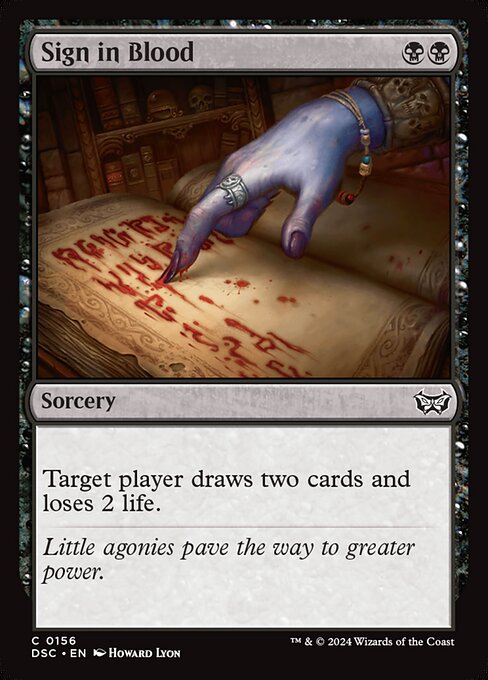
Sign in Blood
Two-mana draw for any black deck
Two life for two cards at instant speed is efficient enough to fit almost any black Commander deck, and it can be pointed at an opponent in a pinch.
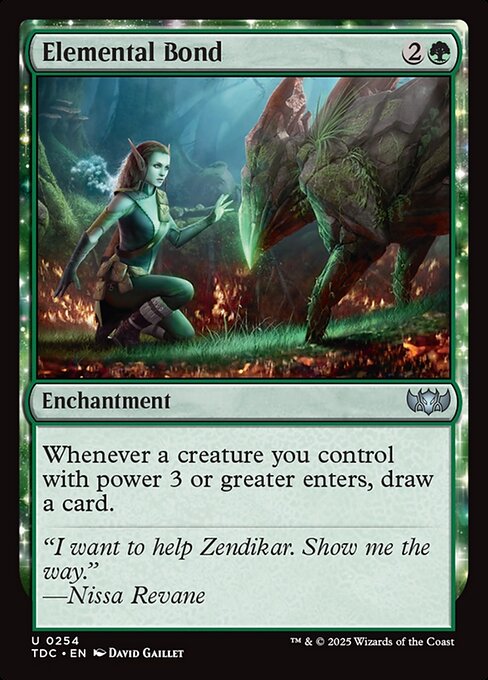
Elemental Bond
Repeatable draw for big creatures
Draws a card whenever a creature with power 4 or greater enters, which turns a creature-heavy green deck's normal game plan into a card advantage engine without extra effort.

Idol of Oblivion
Colorless draw that scales into a threat
Draws a card each upkeep for any deck willing to hold back counters, and eventually flips into a real finisher, which makes it a flexible include outside of green or blue.
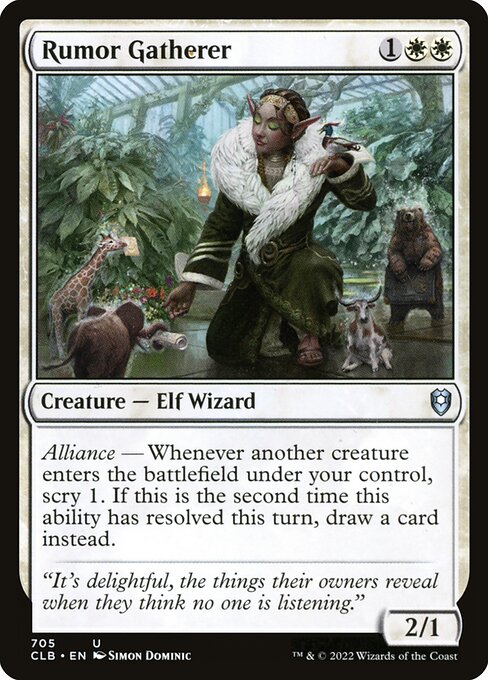
Rumor Gatherer
White card selection with an upside
Surveils and can flip into a repeatable draw engine, giving white decks a card advantage option that does not require combat damage or heavy investment.
Targeted removal: start with 8 to 12 answers
Targeted removal keeps one opponent from running away with the game and keeps the deck from having to race every threat instead of simply answering it.
- Most casual decks should start around 8 to 12 targeted removal or interaction pieces.
- Cover creatures, artifacts, enchantments, and other problem permanents, not just one card type.
- Blue decks can count hard counterspells as part of this total.
- Removal should be cheap enough to use while the deck is still developing.
- Do not lean on board wipes alone to cover this role.
- Can the deck answer a creature?
- Can it answer an artifact?
- Can it answer an enchantment?
- Can it deal with an opposing commander specifically?
- Can it interact at instant speed?
- Does it have answers ready before turn five?
- Does the removal actually fit the deck's colors and the table's speed?
Removal and wipes worth knowing
Beast Within
Universal green answer
Destroys any nonland permanent for three mana, with a 3/3 token as the tradeoff, which is usually a fair price for hitting something your own colors normally cannot touch.
Chaos Warp
Red answer to almost anything
Hits any nonland permanent, including problems the rest of red's removal suite usually cannot reach, at the cost of giving the owner a random replacement.
Blasphemous Act
Board wipe that scales down in cost
Often costs just one or two mana in a deck with several creatures already on the battlefield, making it one of the most efficient resets available in red.
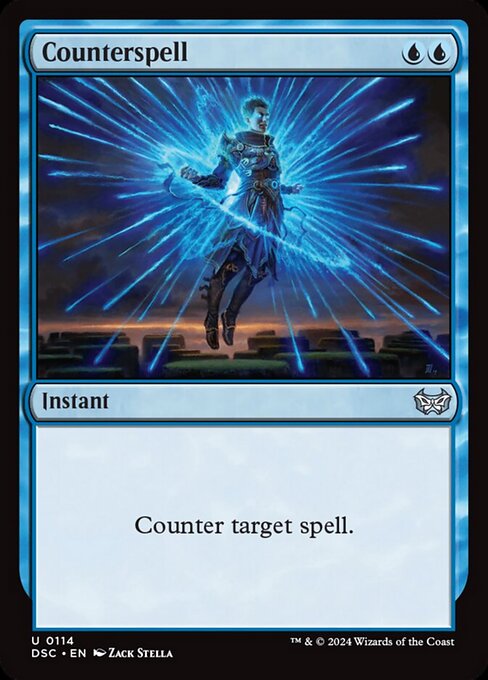
Counterspell
Two-mana hard counter
A clean, unconditional counter that stops a combo piece or a game-ending spell before it resolves, rather than cleaning it up after the fact.
Board wipes: start with 2 to 4
Board wipes are a recovery tool, not a first response. Most casual decks do not need many, but almost every deck benefits from a couple of ways to reset a game it is losing.
- Most Commander decks want 2 to 4 board wipes.
- Creature-light control decks can lean toward the higher end of that range.
- Creature-heavy decks may want fewer, or wipes that spare small creatures.
- Choose wipes the deck can actually recover from, not just ones that look powerful.
- Bounce-based and damage-based wipes count too, as long as they solve the board state.
- Can the deck reset a creature-heavy board?
- Can it recover after casting its own wipe?
- Does it have a wipe ready before the game is already lost?
- Does it need an answer for artifacts and enchantments too, not just creatures?
- Does the wipe hurt the deck's own board as much as the opponents'?
- Does the wipe fit the deck's colors and overall plan?
Austere Command, Cleansing Nova, Day of Judgment, and Hour of Revelation cover white. Evacuation, Aetherize, Aetherspouts, and Devastation Tide bounce rather than destroy. Crux of Fate, Languish, Deadly Tempest, and Mutilate handle black. Blasphemous Act, Chain Reaction, Starstorm, and Burn Down the House scale with red's cheap, board-dependent wipes. Green's options are narrower, but Bane of Progress resets any board that has gotten out of hand on nonbasic permanents.
Protection: play 2 to 6 ways to keep key cards alive
Protection matters most in decks that depend on one commander or one key engine piece. A deck that falls apart the moment its commander dies needs more of this role than a deck built around many redundant, replaceable threats.
- Does the deck fall apart if the commander dies once?
- Can it protect its most important engine piece, not just the commander?
- Can it survive a board wipe without losing its whole plan?
- Does it need protection from removal, from combat, or from both?
- Does the protection actually fit the deck's colors?
Swiftfoot Boots and Lightning Greaves protect a commander from removal and let it attack the turn it enters. Tamiyo's Safekeeping, Snakeskin Veil, and Blacksmith's Skill are cheap, flexible hexproof or protection effects. Unbreakable Formation and Make a Stand protect a whole board from a wipe. Eerie Interlude blinks a board away from a removal spell or a wipe and lets value creatures trigger again. Boros Charm, Counterspell, and Arcane Denial protect from the stack instead of after the fact.
Graveyard hate: play 1 to 3 pieces
Casual Commander players often skip graveyard hate entirely, right up until they lose to a reanimation, escape, or flashback turn they had no way to stop. A small amount of graveyard interaction prevents a lot of blowouts.
- Can the deck stop a reanimation or escape turn?
- Can it answer a graveyard-based value engine?
- Is the hate one-sided, or does it hurt the whole table equally?
- Does the piece replace itself, so it is not a dead card in a normal game?
- Does it fit into a land or artifact slot that was already flexible?
Bojuka Bog fits into any land slot and exiles a graveyard on entry. Soul-Guide Lantern, Tormod's Crypt, Relic of Progenitus, and Nihil Spellbomb are cheap artifacts that do the same job while replacing themselves. Scavenger Grounds and Remorseful Cleric add repeatable or creature-based graveyard hate. Unlicensed Hearse grows into a real threat while quietly shutting off graveyard strategies.
Recursion: play 2 to 6 ways to get cards back
Recursion gives a deck resilience against removal and lets budget decks reuse their best cards instead of buying more copies of similar effects. It matters most in decks built around one or two key pieces.
Creature decks lean on Eternal Witness, Regrowth, Bala Ged Recovery, and Timeless Witness to rebuy anything from the graveyard. Spellslinger decks want Mystic Retrieval, Mnemonic Wall, and Archaeomancer to reuse instants and sorceries. Artifact decks can lean on Myr Retriever, Junk Diver, and Trading Post. White decks get repeatable value from Sun Titan, Sevinne's Reclamation, and Late to Dinner. Black decks looking to rebuild after a wipe or a removal spell can turn to Victimize, Dread Return, and Unearth for cheap reanimation.
Win conditions: play 2 to 6 clear ways to close the game
Plenty of Commander decks generate a mountain of value and then never actually win. A checklist needs finishers built in, not just engines that make more cards.
- How does this deck actually win a game?
- Can it close things out after it has already won the value fight?
- Are the win conditions supported by what the commander actually does?
- Are there too many unrelated win conditions competing for the same slots?
- Does the deck need a combat finisher, a combo, a drain plan, or a big value swing?
- Can the win condition survive a removal spell or a counter?
Overrun-style combat effects, commander damage, aristocrats-style drain, a two-card combo, a token swarm, a big X-spell, extra combat steps, reanimation targets, and a value engine that eventually turns lethal can all work as a win condition, as long as the rest of the deck supports one or two of them instead of all of them at once.
Mana curve: make sure the deck plays before turn four
A deck can have the right land count, ramp, and draw and still feel clunky if its curve sits too high. Commander decks need real plays before turn four, not a hand full of five and six mana spells waiting on enough lands to show up.
- Does the deck have plays before turn three?
- How many spells cost five mana or more?
- Can the deck double-spell in the midgame, or does every turn spend all of its mana on one card?
- Are the expensive cards actually better than a cheaper synergy card doing a similar job?
- Does the commander's own mana value push the curve higher than it looks on paper?
- Are there too many seven-mana cards competing for the same late-game turns?
- Are the deck's interaction spells cheap enough to hold up on a normal turn?
High-curve decks need more lands and ramp to support them. Low-curve decks need enough draw to avoid running out of gas. Expensive commanders need extra early setup to reach their mana value on time. When trimming the curve, cut redundant, win-more top end before cutting anything structural.
Synergy and flex slots: add the deck's identity last
Once the checklist above is covered, the remaining slots become the deck's actual identity: commander synergy, theme cards, pet cards, meta answers, and extra finishers.
Every nonland card in the deck should usually fall into one of these roles: ramp, draw, removal, protection, graveyard hate, recursion, an enabler, a payoff, a win condition, or a meta answer. A card that does not fit any of these roles is worth a second look as a possible cut, no matter how much you like it.
Use the Deckcipher Commander Deck Building Checklist
Check your deck before you start cutting cards
Use the Deckcipher Commander Deck Building Checklist to review your lands, ramp, draw, removal, board wipes, protection, graveyard hate, win conditions, and curve in one place.
Common Commander deck building checklist mistakes
- Cutting lands to fit more exciting cards.
- Playing plenty of ramp but not enough card draw to back it up.
- Playing card draw that does not match the deck's actual plan.
- Running too little targeted removal.
- Relying only on board wipes instead of cheaper targeted answers.
- Playing board wipes that hurt your own deck as much as the opponents'.
- Skipping graveyard hate entirely.
- Building value engines with no real way to win.
- Trying to support too many unrelated themes at once.
- Copying deck ratios from a commander with a totally different game plan.
- Treating budget cards as automatically weak just because they are cheap.
- Treating expensive staples as mandatory in every single deck.
- Forgetting that colored sources matter as much as total land count.
Final Commander deck building checklist
- Do I have 36 to 38 lands, or the right adjusted count for this deck?
- Do I have enough colored sources for every color I am playing?
- Do too many of my lands enter tapped?
- Do I have 10 to 12 ramp pieces, adjusted for my commander's cost?
- Do I have enough two-mana ramp to matter early?
- Do I have 8 to 12 card draw or card advantage pieces?
- Does my card draw actually match my deck's plan?
- Do I have 8 to 12 targeted removal or interaction pieces?
- Do I have 2 to 4 board wipes I can recover from?
- Do I have protection if my commander or a key engine is important?
- Do I have at least 1 to 3 graveyard hate pieces?
- Do I have recursion if the deck needs resilience?
- Do I know exactly how this deck wins?
- Do my synergy cards actually support the commander's plan?
- Build the mana base first.
- Add ramp.
- Add card draw.
- Add removal.
- Add board wipes.
- Add protection and graveyard hate.
- Add win conditions.
- Fill the rest with synergy and theme cards.
- Test a few opening hands.
- Adjust the deck after real games.
FAQ
What should every Commander deck include?
Most Commander decks should include lands, ramp, card draw, targeted removal, board wipes, protection, graveyard hate, win conditions, and synergy cards that support the commander's plan.
How many lands should a Commander deck have?
Most casual Commander decks should start with 36 to 38 lands. Low-curve decks can sometimes play fewer, while expensive commanders, battlecruiser decks, and landfall decks often need more.
How much ramp should a Commander deck play?
Most Commander decks should start around 10 to 12 ramp pieces. Low-curve decks can play 8 to 10, while five-mana commanders, six-mana commanders, and big-mana decks usually want more.
How much card draw should a Commander deck have?
Most casual Commander decks should run around 8 to 12 card draw or card advantage pieces. The best draw depends on the deck's plan, colors, and commander.
How much removal should a Commander deck play?
Most Commander decks should start with around 8 to 12 targeted removal or interaction pieces. This can include removal spells, counterspells, bounce effects, artifact and enchantment removal, or other flexible answers.
How many board wipes should a Commander deck have?
Most casual Commander decks should play around 2 to 4 board wipes. Creature-light control decks may play more, while creature-heavy decks may use fewer or choose asymmetrical wipes instead.
Does every Commander deck need graveyard hate?
Most decks should play at least 1 to 3 graveyard hate pieces. Graveyard strategies are common in Commander, and cheap options like Bojuka Bog, Soul-Guide Lantern, and Tormod's Crypt can stop major threats for very little investment.
How many win conditions should a Commander deck have?
Most casual decks should have around 2 to 6 clear win conditions or finisher packages. Some commanders are win conditions by themselves, while others need dedicated finishers built around them.
Should I build around ratios or synergy?
Use ratios to build the deck's foundation, then use synergy to make the deck unique. A deck with great synergy but not enough lands, ramp, draw, or removal will usually still feel inconsistent.
Conclusion
A Commander deck building checklist is not meant to make every deck the same. It is meant to make sure your deck works before you fill the last slots with synergy, pet cards, and expensive upgrades. Start with lands, ramp, card draw, targeted removal, and board wipes. Then add protection, graveyard hate, recursion, win conditions, and commander-specific synergy. Once the foundation is solid, your deck will cast spells more consistently, recover better, answer more threats, and actually close games.