

Most Commander decks do not need a random upgrade first, they need a diagnosis. A deck can feel weak for a lot of different reasons: it misses land drops, it never ramps into anything, it runs out of cards by the midgame, it has no real answers, its curve is clunky, it has no clear way to win, or it is simply playing above or below the table's power level. Before you spend money on anything, run your list through the Commander Deck Audit and use this guide to decide what to fix first.
The Commander deck audit order
When a Commander deck feels inconsistent, fix the mana base first. Then check land count, colored sources, ramp, card draw, removal, curve, win conditions, and synergy in that order. Most struggling decks do not need more expensive cards right away. They need enough lands to function, enough colored sources to cast spells, enough ramp to develop, enough draw to keep playing, and enough interaction to survive.
- Mana base quality
- Land count
- Colored sources
- Ramp count
- Card draw count
- Targeted removal
- Board wipes
- Mana curve
- Win conditions
- Deck focus and synergy
- Dead cards and win-more cards
- Bracket pressure and Game Changers
- Budget upgrades
A deck audit should not start with "what powerful card can I add next?" It should start with "what part of the deck is actually failing?" If the deck cannot cast its spells on time, no expensive win condition will fix that. If it runs out of cards by turn eight, adding another threat will not help. If it cannot answer a problem on the board, it will lose to that problem even with a perfect synergy piece sitting in hand. Fix the structure before you tune the power level.
Deckcipher deck audit score
A Commander deck usually improves fastest when you fix the highest-impact structural issue first. Mana consistency carries the most weight in that score because every other card in the deck, from ramp to removal to your commander itself, depends on being cast on time.
What to fix first
If you just want a fast answer before reading the rest of this guide, match what you are seeing at the table to the row below. It will not replace a full audit, but it will point you at the right section to read first.
What to fix first, by symptom
| Problem you see | Likely issue | First fix |
|---|---|---|
| Missing land drops | Land count is too low, or too many lands enter tapped | Add lands and cut some tapped lands |
| Hand empties quickly | Not enough card draw or card advantage | Add 2-4 more draw or card advantage pieces |
| Too slow early | Not enough ramp, or ramp costs too much mana | Add cheap ramp that comes down on turn two or three |
| Dies before doing anything | Not enough interaction or protection | Add cheap removal, and protection for key pieces |
| Deck does random things | No clear win condition or too many unrelated plans | Pick one or two win conditions and build toward them |
| Table says it feels too strong | Too many Game Changers or too much fast mana for the pod | Recheck your bracket and cut or swap the biggest offenders |
| Deck is too expensive | Price is concentrated in a few luxury upgrades | Find budget swaps for the cards driving up the price |
Fix the mana base first
The mana base is the first thing worth auditing because every other card in the deck depends on it. A deck can be full of powerful, well-chosen cards and still play like a pile of dead weight if it cannot reliably get its lands and colors on time.
- Total land count
- Colored source count for each color you play
- Number of lands that enter tapped
- Number of colorless utility lands
- Whether the mana base supports early plays, not just late ones
- Whether you can cast your commander on curve
- Whether your ramp spells can actually be cast early enough to matter
- Whether the mana base matches how color-intensive the deck really is
Most casual Commander decks start around 36 to 38 lands. Low-curve decks with cheap spells and strong card draw can sometimes run a couple fewer. Expensive commanders, battlecruiser decks, landfall decks, and mana-hungry three-plus-color decks usually want a few more, not fewer.
Check land count before you cut anything
Land count is one of the least exciting things to fix and one of the most important. Plenty of players trim lands to make room for one more exciting card, then wonder why the deck feels worse instead of better.
Land count by deck profile
| Deck profile | Starting land count | When to adjust |
|---|---|---|
| Low-curve deck | 34-36 | Only with cheap spells, strong draw, and reliable early ramp |
| Normal casual deck | 36-38 | The best default range for most new lists |
| Five-mana commander | 37-39 | Needs consistent development to reach the commander on curve |
| Six-plus-mana commander | 38-40 | Needs lands and ramp working together, not one instead of the other |
| Battlecruiser deck | 38-42 | Expensive spells need more total mana sources |
| Landfall deck | 40-44 | Lands are part of the payoff, not just a means to an end |
| Precon upgrade | 36-38 | Do not cut lands from a precon just to fit new cards in |
If your deck misses land drops before turn four on a regular basis, the fix is usually more lands, a lower curve, or better early card selection, not a flashier top end.
Check colored sources, not just total lands
A deck can have plenty of lands and still be color-screwed. Total land count tells you whether you will hit your land drops. Colored source count tells you whether your mana can actually cast your spells.
- Your main early color usually needs the most sources of any color in the deck.
- A light splash color can often run on fewer sources if it only matters in the mid or late game.
- Double-pip cards need much heavier source support than single-pip cards at the same cost.
- Lands that enter tapped are weaker for early plays, even though they still count toward your total.
- Colorless utility lands are useful, but too many in a three-plus color deck can quietly wreck your fixing.
- Mana rocks only start counting as real colored sources once your deck can actually cast them.
- Sol Ring is excellent ramp, but it does not fix your colors, so do not count it as a colored source.
Starting colored source targets
| Role | Recommended sources | Notes |
|---|---|---|
| Main early color | 20-24 | The color you need on turn one or two most often |
| Secondary color | 16-20 | Still a core color, just slightly less urgent early |
| Light splash color | 12-15 | Only needs to show up reliably by the mid game |
| Double-pip color on curve | 24+ | Needs meaningfully more support than a single-pip card |
If you are not sure whether your own numbers hold up, running your decklist through the Commander mana base calculator is faster than counting sources by hand.
Check your colored sources
Use the Deckcipher Mana Base Calculator to see whether your deck actually has enough sources for each color before you add more spells.
Audit ramp next
Once lands and colors are solid, ramp is next. Ramp lets a deck develop ahead of a normal one-land-per-turn pace, recast a commander that keeps dying, and play more than one spell in the same turn.
- Most casual decks: 10 to 12 ramp pieces
- Low-curve decks: 8 to 10
- Five-mana commanders: 11 to 13
- Six-plus-mana commanders: 12 to 15
- Battlecruiser decks: 14 to 18
- How many ramp pieces cost two mana or less?
- Does any of your ramp also fix colors?
- Is the ramp permanent, or a one-time burst?
- Are your Treasure sources repeatable, or single use?
- Do your cost reducers actually discount enough cards to matter?
- Are you cutting lands to fit more ramp, then missing land drops anyway?
Ramp worth auditing for

Arcane Signet
Two-mana mana rock
A two-mana rock that only needs colors already in your commander's identity, which makes it an easy include in almost any multicolor deck. Fellwar Stone, Mind Stone, Thought Vessel, the signets, and the talismans fill the same slot.

Rampant Growth
Two-mana land ramp
Land ramp puts an extra land onto the battlefield a turn early, fixes colors along the way, and is harder for opponents to remove than an artifact. Farseek, Sakura-Tribe Elder, Cultivate, and Kodama's Reach cover the same role.

Sakura-Tribe Elder
Creature-based ramp and blocker
Creature ramp adds a body that can block or chump before it cashes in for a land, which is valuable until a board wipe clears it away first.

Nature's Lore
Untapped land ramp
Fetches a land that can enter untapped and count as a Forest for typal effects, which makes it a stronger fixing tool than a plain land ramp spell in decks that need both mana and color support.
Audit card draw and card advantage
A deck can have great mana and still fail if it runs out of cards. Card draw is what keeps a Commander deck functioning past the first few turns instead of stalling out with an empty hand.
- Most casual Commander decks should start around 8 to 12 card draw or card advantage pieces.
- Does the deck draw cards repeatedly, or only once?
- Does the draw match how the deck actually wins?
- Does the deck need combat draw, creature draw, spell draw, token draw, or life-for-cards draw?
- Can the deck recover cards after a board wipe clears the battlefield?
Card draw by deck plan
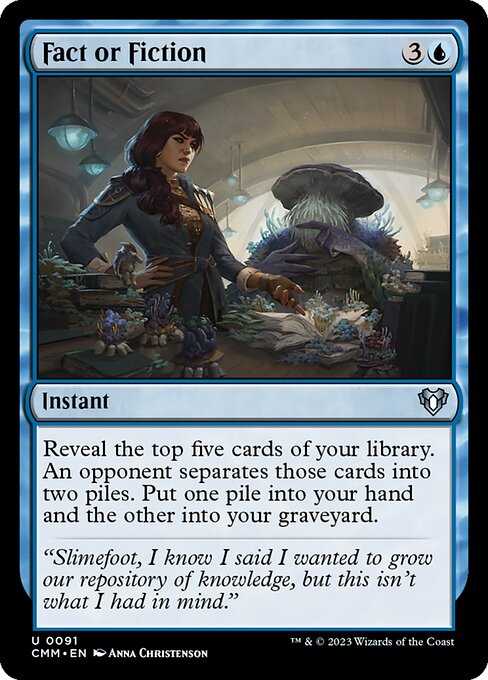
Fact or Fiction
Instant-speed card selection
Splits a chunk of the top of your library into two piles and lets an opponent choose which one you keep, which usually nets several playable cards at instant speed.

Night's Whisper
Cheap card advantage
Two life per card is a fair trade for a reliable two-card draw spell, and it remains one of the most efficient draw effects available to black decks.
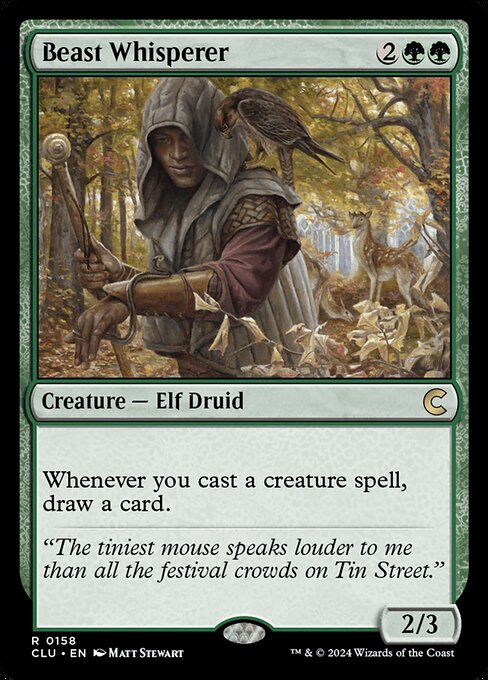
Beast Whisperer
Repeatable green card advantage
Turns every creature you cast into a card, which adds up fast in a creature-heavy shell and keeps the hand full while the deck rebuilds after a wipe.
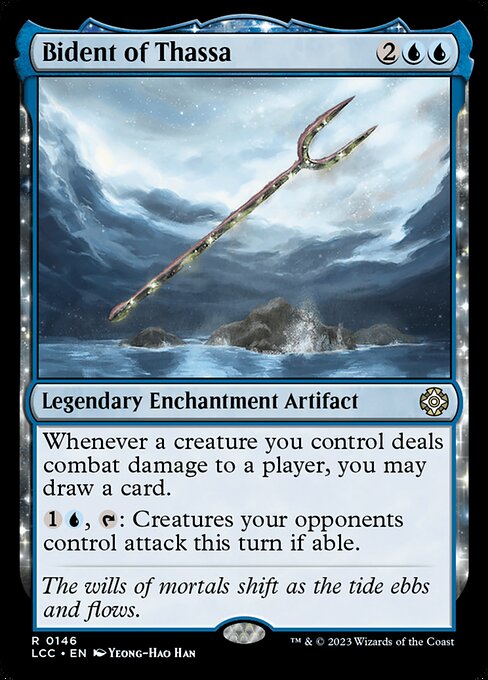
Bident of Thassa
Draw off unblocked damage
Rewards a deck that already wants to attack, drawing a card whenever a creature you control connects, which fits aggressive and token-heavy plans well.
Audit targeted removal
If a deck cannot answer threats, it eventually loses to whichever one it cannot beat, whether that is an opposing combo piece, a problem creature, or a game-ending enchantment. Budget decks especially cannot afford to skip interaction.
- Most casual Commander decks should start around 8 to 12 targeted interaction pieces, depending on colors, commander, and table speed.
- Can the deck answer creatures?
- Can it answer artifacts and enchantments?
- Can it interact with graveyards?
- Can it disrupt a combo, not just a big creature?
- Does it rely only on board wipes with nothing cheaper in between?
- Are enough of the answers instant speed?
Removal worth keeping in the deck

Swords to Plowshares
One-mana exile removal
One mana to exile almost any creature is about as efficient as removal gets, and the life gained rarely matters enough to offset the tempo swing.

Generous Gift
Flexible answer to almost anything
Hits creatures, artifacts, enchantments, planeswalkers, and even lands, which makes it a safe include in any color identity that needs a catch-all answer.

Beast Within
Universal permanent removal
Destroys any nonland permanent for three mana, with a 3/3 token as the tradeoff, usually a fair price for hitting something your colors normally cannot touch.
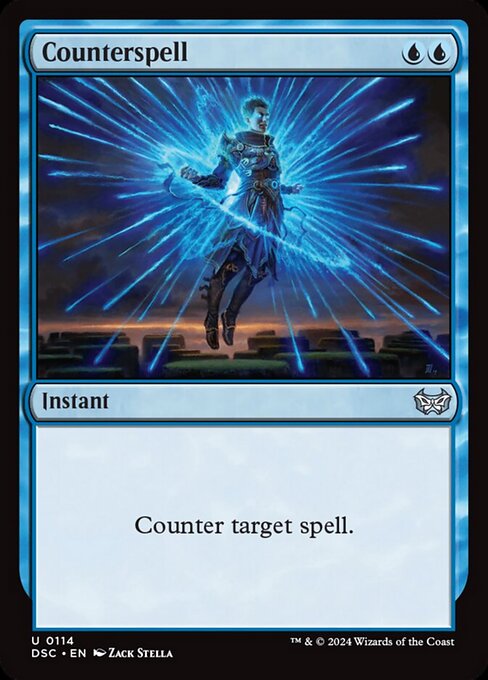
Counterspell
Two-mana hard counter
A clean, unconditional counter for two mana that stops a combo piece or a game-ending spell before it resolves, instead of cleaning it up afterward.
Audit board wipes
Board wipes are a recovery tool, not a first response. Most casual decks do not need many, but almost every deck benefits from having a couple of ways to reset a game it is losing.
- Most Commander decks should start around 2 to 4 board wipes.
- Can the deck recover after its own wipe, or does it just reset back to zero?
- Does the wipe fit the deck's actual colors and plan?
- Is the wipe fast enough to matter, or does it always arrive a turn too late?
- Does the deck need a creature wipe, an artifact and enchantment wipe, or a bounce-style reset?
- Is a creature-heavy deck accidentally punishing its own board with a symmetrical wipe?
Blasphemous Act, Chain Reaction, Austere Command, Cleansing Nova, Crux of Fate, Languish, Evacuation, and Aetherize all fill this role in different colors and at different speeds. Pick the ones that match your deck's colors and your actual plan for recovering afterward.
Audit the mana curve
A deck can have enough lands and enough ramp and still feel clunky if the curve sits too high. Commander decks need real plays before turn four, not just a hand full of five and six mana spells waiting for enough mana to show up.
- How many cards in the deck cost one or two mana?
- How many cost five mana or more?
- Does the deck do anything meaningful before the commander hits the battlefield?
- Are there too many seven-mana haymakers competing for the same late-game turns?
- Can the deck double-spell in the midgame, or does every turn spend all of its mana on one card?
- Are reactive spells cheap enough that the deck can actually hold them up?
Curve problems and fixes
| Problem | Symptom | Fix |
|---|---|---|
| Curve too high | Hand full of spells you cannot cast yet | Cut some of the top end, or add ramp and lands |
| Too few early plays | First real play happens on turn four or later | Add cheap ramp, draw, or interaction |
| Too many reactive expensive cards | Cannot hold up answers on a normal turn | Lower the average cost of your interaction |
| Too many haymakers | Deck looks powerful on paper but stalls in play | Cut redundant top-end cards for cheaper effects |
Audit win conditions
Plenty of Commander decks either have no clear way to close a game or have so many unrelated win conditions that none of them are actually supported. Both problems feel the same at the table: the deck grinds out value and then never quite wins.
- How does this deck actually win a game?
- Does the commander support that plan, or just sit there as a value engine?
- Are there enough finishers, or just one that dies to a single removal spell?
- Are the finishers so expensive the deck rarely lives long enough to cast them?
- Does the deck have a way to close a game after it has already won the value fight?
- Are combo pieces backed up by any redundancy or tutors, or is it a one-shot plan?
Combat with an overrun-style effect, commander damage, aristocrats-style drain, a two-card combo finish, a token swarm, a big X-spell, extra combat steps, reanimation, and a value engine that turns into a finisher can all work as a win condition, as long as the rest of the deck is built to support one or two of them, not all of them at once.
Check bracket pressure and table fit
Sometimes a deck is not actually broken, it just does not fit the table. If every game ends with the same complaint about your deck, that is worth auditing too, and the fix is not always more power. Sometimes it is less.
- How many Game Changers does the deck play, and does the table actually agree to that bracket?
- Is the deck relying on fast mana and a low curve to win before turn six against decks that are not built to keep up?
- Would cutting one or two of the strongest cards change how the deck feels to play against, without gutting it?
- Is the deck's price tag itself creating a power gap, even if the raw card quality is only a little higher than the rest of the pod?
- Does the deck's power level match what you actually want out of the games you are playing?
Game Changers are not banned, but a deck loaded with them plays differently than one without them, and that shift is exactly what a table power conversation should be based on. Check your list against the Game Changers checker and the bracket calculator if you are not sure where your deck actually lands. If price, not raw power, is the real gap between your deck and the table, the deck price calculator and the Commander budget alternatives tool can help you find swaps that lower the cost without gutting what the deck does.
Audit deck focus and synergy
Once the structure works, check whether the deck's cards are actually pulling in the same direction. A lot of decks underperform not because any single card is weak, but because the deck is a pile of good cards instead of a coherent plan.
- Does each card support what the commander is actually trying to do?
- Is the deck trying to do two or three unrelated things at once?
- Are there powerful cards in the deck that are simply off-plan?
- Are there pet cards that do not meaningfully contribute to winning or surviving?
- Are generic expensive staples taking slots that a cheaper synergy card would fill better?
- Does the deck have enough payoffs for its enablers, and enough enablers for its payoffs?
Every nonland card in the deck should usually fall into one of these roles: ramp, card draw, removal, protection, an enabler, a payoff, a win condition, recursion, or a meta answer. A card that does not fit any of these roles is worth a second look as a possible cut.
Budget and precon audit
Do not start a deck audit by shopping for expensive cards. First figure out whether the deck's real problem is structural. An expensive staple only helps if it solves the issue the deck actually has, and most of the fixes above cost very little.
- Is this expensive card core to what the deck does, or a generic staple almost any deck could use?
- Is it a luxury upgrade, or is it replacing a cheaper card that would fill the same role just as well?
- Is it raising the deck's power meaningfully above the rest of the table?
- Is it actually worth adding for this specific commander's plan?
- Replace the slowest ramp first, most precons ship with a few clunky three or four mana rocks.
- Check the land count before adding more ramp, do not stack ramp on top of a thin mana base.
- Replace generic three-mana rocks with a two-mana signet or talisman when one is available.
- In green precons, add cheap land ramp like Rampant Growth, Farseek, or Sakura-Tribe Elder.
- In non-green precons, prioritize rocks that enter untapped or that fix more than one color.
- Keep any synergy ramp, like a cost reducer or a Treasure engine, if it genuinely supports the deck's plan.
Use the Deckcipher Mana Base Calculator
Check your mana base before changing the deck
Most Commander deck problems start with mana. Use the Deckcipher Mana Base Calculator to check land count, colored sources, color fixing, and early mana consistency before you add another card.
Example audit walkthrough
Here is what this looks like on an actual list. Say you are running a five-color Dragons deck: 34 lands with a lot of them entering tapped, 8 ramp pieces, an average mana value close to 4, and only 6 card draw spells. The pilot says it feels clunky and runs out of gas after the first big Dragon dies.
- Add lands and fixing first. Five colors with 34 lands and heavy tapped-land count is a mana problem before it is anything else. Push toward 38-40 lands and prioritize sources that enter untapped or fix more than one color.
- Add ramp next. 8 pieces is light for a five-color deck with a curve this high. Bring it up toward 12-14, and favor ramp that also fixes colors over ramp that only adds generic mana.
- Cut some of the expensive top end. An average mana value near 4 with only 34-38 lands and 8 ramp pieces means the deck is trying to cast more than its mana can support. Trim a few of the redundant six and seven mana Dragons before adding anything new.
- Add card draw. 6 draw spells is too few for a deck that loses its board to removal or a wipe and needs to rebuild. Push toward 10-12, and prioritize draw that survives losing a single big creature.
- Upgrade threats last. Once the mana, curve, and draw are solid, it is safe to start swapping in more powerful Dragons, because now the deck can actually reach them and recover after losing one.
Notice what is not on that list: the deck does not need a more powerful commander, a combo finish, or a copy of an expensive staple to feel better. It needs to reliably reach its plan, which is exactly what a mana, ramp, curve, and draw pass fixes.
Run your own deck through the same process
Run the audit, look for the biggest red flag, fix that first, then re-check the deck. Repeat that loop a few times and most decks tighten up fast.
Common Commander deck audit mistakes
- Adding expensive staples before fixing the mana base.
- Cutting lands to make room for more exciting cards.
- Checking land count and ignoring colored sources entirely.
- Running plenty of ramp but not enough card draw to back it up.
- Playing card draw that does not match the deck's actual strategy.
- Running too little targeted removal and leaning only on board wipes.
- Playing board wipes that wreck your own board as much as the opponents'.
- Keeping a high curve without the mana support to actually cast it.
- Building a deck with no clear win condition.
- Trying to do too many unrelated things at once.
- Calling every pet card "synergy" instead of cutting it.
- Copying a high-power deck's ratios into a much more casual list.
Final Commander deck audit checklist
- Do I have the right land count for this commander and curve?
- Do I have enough colored sources for each color I am playing?
- Do too many of my lands enter tapped?
- Can I cast my commander on time?
- Do I have around 10 to 12 ramp pieces, adjusted for my commander's cost?
- Do I have 8 to 12 card draw or card advantage pieces?
- Do I have 8 to 12 targeted interaction pieces and 2 to 4 board wipes?
- Is my mana curve too high for my land and ramp count?
- Do I know how this deck actually wins?
- Which cards are dead, win-more, or simply off-plan?
- Does the deck's Game Changer count and price match how the table actually plays?
- Fix the mana base.
- Fix the land count.
- Fix the colored sources.
- Fix the ramp.
- Fix the card draw.
- Fix the interaction.
- Fix the curve.
- Clarify the win conditions.
- Cut the off-plan cards.
- Check bracket pressure and price.
- Upgrade power last.
FAQ
What is a Commander deck audit?
A Commander deck audit is a structured check of what a deck actually does: its land count, colored sources, ramp, card draw, removal, curve, and win conditions. Instead of judging a deck by which cards look powerful, an audit looks at whether the deck can consistently do its job.
What should I fix first in a Commander deck?
Fix the mana base first. Check land count, colored sources, tapped lands, ramp, and whether the deck can cast its commander on time. If the deck cannot cast spells consistently, other upgrades will not matter much.
How do I know if my Commander deck has a bad mana base?
A mana base is probably weak if you miss early land drops, have lands but the wrong colors, cannot cast your commander on time, play too many tapped lands, or run too many colorless utility lands in a multicolor deck.
How many lands should a Commander deck have?
Most casual Commander decks should start around 36 to 38 lands. Low-curve decks can sometimes play fewer, while expensive commanders, battlecruiser decks, and landfall decks usually need more.
How much ramp should a Commander deck play?
Most Commander decks should start around 10 to 12 ramp pieces. Low-curve decks can play 8 to 10, while expensive commanders and big-mana decks often want 12 to 15 or more.
How much card draw should a Commander deck have?
Most casual Commander decks should start with around 8 to 12 card draw or card advantage pieces. The best draw cards depend on the deck's plan: creature decks, token decks, control decks, and spellslinger decks all want different draw engines.
How much removal should a Commander deck play?
Most casual Commander decks should start with around 8 to 12 targeted removal or interaction pieces plus 2 to 4 board wipes. Adjust based on your commander, colors, and table power level.
Why does my Commander deck feel inconsistent?
Common causes include too few lands, weak colored sources, too little ramp, not enough card draw, a high mana curve, too many tapped lands, unclear win conditions, or too many off-plan cards.
Should I add expensive staples to fix my Commander deck?
Not right away. Expensive staples only help if they solve the deck's actual problem. Fix mana, ramp, draw, interaction, curve, and win conditions first, then decide whether an expensive upgrade is worth it.
How do I audit a precon upgrade?
Start by checking land count, tapped lands, ramp quality, card draw, removal, and win conditions. Many precons improve quickly by replacing slow ramp, adding better interaction, and tightening the deck's main theme.
Can a deck audit tell me my Commander bracket?
A deck audit can flag the signals that push a deck into a higher bracket, like Game Changers, fast mana, and a low curve backed by heavy interaction, but the bracket itself is a table conversation. Use the audit alongside a Game Changers checker and bracket calculator to get a fuller picture before you sit down to play.
Conclusion
A good Commander deck audit starts with the foundation. Fix the mana base before buying expensive cards. Check land count, colored sources, ramp, card draw, interaction, curve, win conditions, synergy, and bracket pressure in that order. Most struggling decks do not need more flashy cards first, they need to cast spells on time, keep cards flowing, answer threats, and close games. Once the structure works, upgrades become much easier to evaluate. The best fix is not always the most powerful card, it is the change that solves the deck's biggest problem. Run the audit, find the biggest red flag, fix that first, then check again.