
The short answer: start with 8 to 12 draw pieces
Most casual Commander decks should start with about 8 to 12 card draw or card advantage pieces. Decks with commanders that reliably draw cards can sometimes run closer to 6 to 8 dedicated draw spells, while high-curve decks, control decks, midrange decks, and decks without built-in draw often want 10 to 14 or more. The right number depends on whether your draw is repeatable, whether it fits your strategy, and whether the deck can recover after a board wipe.
- Commander reliably draws cards: 6 to 9 dedicated draw pieces
- Normal casual decks: 8 to 12 draw pieces
- High-curve decks: 10 to 14 draw pieces
- Control decks: 10 to 14 draw pieces
- Midrange decks: 9 to 13 draw pieces
- Aggro or low-curve decks: 7 to 10 draw pieces
- Token decks: 8 to 12 draw pieces, preferably repeatable engines
- Spellslinger decks: 8 to 12 draw and selection pieces combined
- Precon upgrades: usually aim for 8 to 12 reliable draw pieces
- Decks running mostly one-shot draw should play more total draw than decks with repeatable engines
Card draw is not just about drawing one extra card. Commander games are long, multiplayer affairs where players trade resources for many turns in a row. A deck that ramps but never draws will empty its hand. A deck full of threats but no way to refuel will stall out after the first board wipe. The best draw package is not a pile of famous staples, it is a mix that keeps your deck doing its thing turn after turn.
Deckcipher card draw count formula
| Adjustment | When it applies |
|---|---|
| Start at 10 | Base draw count for a normal casual Commander deck |
| -1 to -3 | Commander reliably draws cards on its own |
| +1 to +2 | Commander is expensive or gets removed often, so you need backup |
| +1 to +3 | Average mana value is on the high side |
| +1 to +2 | Deck runs a lot of ramp and needs cards to spend the extra mana on |
| +1 to +2 | Deck plays many one-for-one answers and needs to refill after trading |
| -0 to -2 | Deck already has several repeatable draw engines |
| +1 to +3 | Deck's draw is mostly one-shot instead of repeatable |
| +1 to +3 | Deck tends to empty its hand quickly |
| Match the plan | Prioritize combat draw in combat decks, creature draw in creature decks |
| Fix quality first | Precon upgrades should replace clunky draw before adding expensive staples |
What counts as card draw in Commander?
Card draw is any effect that increases your access to cards, but not every card-access effect should be counted the same way when you total up your deck's numbers. Lumping them all together is how decks end up with a hand full of cantrips and no actual card advantage.
- True card draw, like Night's Whisper
- Repeatable card advantage engines, like Beast Whisperer
- One-shot refills, like Fact or Fiction
- Cantrips that mostly replace themselves
- Looting and rummaging effects
- Impulse draw that has to be spent quickly
- Card selection that improves quality more than quantity
- Tutors that find one specific card
- Commander-based draw
- Token, creature, combat, or spell-triggered draw
Night's Whisper is straightforward card draw, two cards for two mana and two life. Fact or Fiction is more accurately card advantage and selection rolled together, since the size of the piles and what your opponent chooses both matter. Beast Whisperer is a real repeatable draw engine, but only in a deck that is actually casting a steady stream of creatures. Idol of Oblivion only functions as repeatable draw if your deck reliably makes tokens to feed it. Ponder and Preordain are excellent at finding the right card at the right time, but they usually replace themselves rather than adding to your total resources, so they are closer to selection than advantage. Faithless Looting filters your hand, but unless your deck cares about its graveyard, discarding a card to draw a card is not a net gain. Impulse draw counts as real card advantage only if your deck can reliably cast what it finds before the effect expires, and a tutor gets you the exact card you need without actually drawing more cards.
The default Commander card draw count
A normal casual Commander deck with a reasonable curve and a commander that does not draw cards should usually start around 10 draw or card advantage pieces. If the commander draws cards reliably, you may be able to play a couple fewer. If the deck has a high curve, a lot of ramp, or a plan that tends to empty its hand quickly, you usually need more, not fewer.
Treat this as a starting point rather than a hard rule. Commander, colors, curve, ramp, and strategy all push the number up or down, and a deck that ignores all of them in favor of a single fixed ratio usually ends up either flooding on draw spells it does not need or running dry by the midgame.
Card draw count by deck profile
| Deck profile | Recommended draw count | Best draw type | Notes |
|---|---|---|---|
| Commander draws cards reliably | 6-9 | Backup engines and refills | Do not rely only on the commander |
| Normal casual deck | 8-12 | Mixed engines and refills | The best starting point for most new lists |
| High-curve deck | 10-14 | Repeatable draw and big refills | Needs cards to spend the extra mana on |
| Control deck | 10-14 | Instant-speed draw and engines | Trades resources with the table often |
| Aggro or low curve | 7-10 | Cheap draw and combat draw | Needs to reload after emptying its hand fast |
| Token deck | 8-12 | Token-based engines | Draw should reward the token plan, not fight it |
| Creature deck | 8-12 | Creature-cast or creature-ETB draw | Draw should follow the deck's normal game plan |
| Spellslinger deck | 8-12 | Cantrips, refills, spell engines | Selection matters more here than in most decks |
| Precon upgrade | 8-12 | Efficient, on-theme draw | Replace clunky draw before adding expensive staples |
Card draw count by commander
Your commander changes the right draw count more than almost anything else in the deck. Some commanders are draw engines in their own right. Others are mana sinks, combat threats, or synergy pieces that need support from the other 99 cards.
Card draw count by commander type
| Commander type | Draw count adjustment | Why |
|---|---|---|
| Draws cards every turn | 6-9 dedicated draw pieces | The commander is already the main engine |
| Draws only with setup | 8-11 draw pieces | Needs backup for the turns setup fails |
| Expensive to cast | 10-13 draw pieces | Needs backup both before and after casting it |
| Removed or countered often | 10-13 draw pieces | Cannot depend on a commander that keeps leaving |
| A combat threat | 8-12 draw pieces | Lean on combat draw plus protection |
| A combo piece | 8-12 draw and selection pieces | Needs consistency and a backup plan |
| Does not draw at all | 10-12 or more draw pieces | The other 99 cards have to supply the resources |
Card draw count by deck type
Card draw count by archetype
| Deck type | Recommended draw | Best draw style | Why |
|---|---|---|---|
| Aggro or low curve | 7-10 | Cheap draw and combat draw | Needs to reload after fast starts |
| Midrange | 9-13 | Repeatable engines and refills | Needs steady cards over a long game |
| Control | 10-14 | Instant-speed draw and engines | Trades resources constantly |
| Spellslinger | 8-12 | Cantrips, looting, spell payoffs | Selection and velocity matter a lot |
| Aristocrats | 8-12 | Sacrifice draw and death triggers | Turns creatures dying into cards |
| Tokens | 8-12 | Token draw and combat draw | The board state creates the draw condition |
| Voltron | 7-10 | Commander draw plus equipment or aura support | Needs protection and ways to reload |
| Creature decks | 8-12 | Creature-cast and creature-ETB draw | Draw should follow the normal game plan |
| Graveyard decks | 8-12 | Looting, self-mill, recursion | The graveyard can become a form of card access |
| Big mana or battlecruiser | 10-14 | Large refills and engines | Needs cards to spend all that mana on |
| Precon upgrade | 8-12 | Efficient, on-theme draw | Most precons improve quickly with better draw |
Repeatable draw versus one-shot draw
A good draw package almost always mixes repeatable engines with one-shot refills. Neither one covers every situation on its own.
- Repeatable draw is better over long games, but it often needs setup and is vulnerable to removal.
- One-shot draw gives you cards right now, which is safer against removal but weaker if the game drags on.
- Most decks want at least 3 to 6 repeatable draw engines.
- Most decks also want 3 to 6 one-shot draw or refill effects.
- Decks with commander-based draw can run fewer engines, but they still need backup for when the commander is gone.
- Decks that only run one-shot draw usually need to play more total draw pieces to compensate.
Repeatable draw versus one-shot draw
| Draw type | Best for | Examples | Warning |
|---|---|---|---|
| Repeatable engine | Long games | Beast Whisperer, Phyrexian Arena, Idol of Oblivion | Usually needs time or setup to start paying off |
| One-shot refill | Immediate recovery | Fact or Fiction, Read the Bones, Shamanic Revelation | Cards run out again once the effect resolves |
| Combat draw | Creature decks | Reconnaissance Mission, Coastal Piracy | Only as good as the deck's ability to connect in combat |
| Impulse draw | Red decks | Light Up the Stage, Commune with Lava | Cards can expire if you cannot cast them in time |
| Looting or rummaging | Graveyard decks | Faithless Looting, Cathartic Reunion | Not always true advantage unless the graveyard matters |
| Card selection | Spellslinger or control decks | Ponder, Preordain, Thirst for Discovery | Improves quality, not always quantity |
Best card draw categories by color
Every color draws cards differently, and the best pick is usually the one that lines up with what your deck is already doing rather than the most famous staple in that color.
Card draw by color
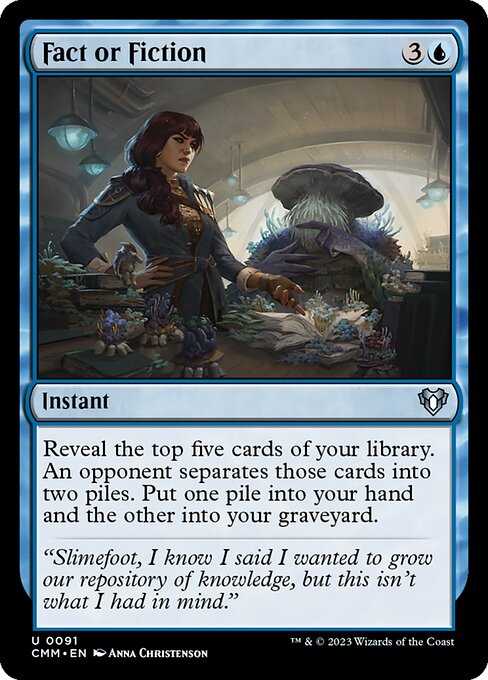
Fact or Fiction
Instant-speed card advantage
Blue decks often get strong selection and instant-speed refills, which control and spellslinger decks want so they can hold up mana for interaction. Flow of Knowledge, Thirst for Discovery, Reconnaissance Mission, Coastal Piracy, and Bident of Thassa all fill a similar role.

Night's Whisper
Efficient card advantage
Black is excellent at trading life for cards, and these effects tend to be cheap and efficient, especially for midrange and aristocrats decks. Sign in Blood, Read the Bones, Deadly Dispute, Village Rites, and Phyrexian Arena cover the same ground at different price points.
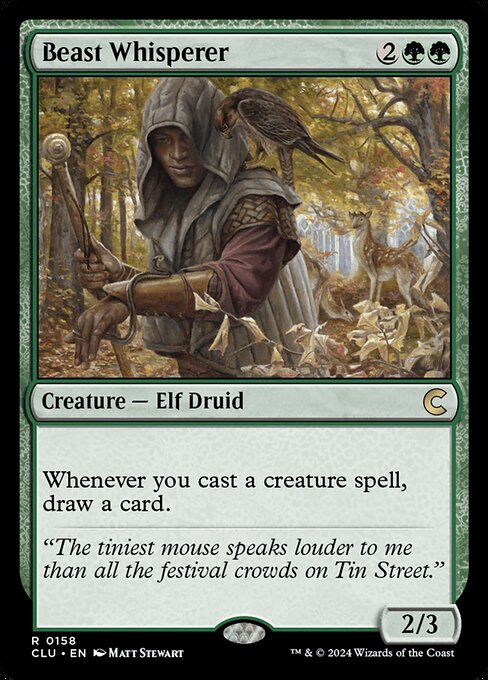
Beast Whisperer
Draw from creatures
Green draw is strongest when the deck is already casting a steady stream of creatures or leaning on big ones. Guardian Project, Garruk's Uprising, Elemental Bond, and Shamanic Revelation all reward the same kind of creature-heavy game plan.

Welcoming Vampire
Incremental value
White draw usually rewards small creatures, attacking, or specific board states rather than handing out unconditional cards, which makes it more conditional than blue or black draw. Tocasia's Welcome, Rumor Gatherer, Mangara the Diplomat, and Mentor of the Meek all lean on a similar plan.

Big Score
Temporary card access and burst resources
Red card advantage tends to come through impulse draw, rummaging, and Treasure-fueled burst turns, so count it carefully since some of it has to be spent quickly. Unexpected Windfall, Faithless Looting, Cathartic Reunion, Light Up the Stage, and Professional Face-Breaker all play a similar role.

Idol of Oblivion
Draw for decks without strong color access
Colorless draw is usually slower or more conditional, but it helps decks that need extra card flow outside their main colors or want draw that fits any color identity. Tome of Legends, Endless Atlas, Mind's Eye, Mazemind Tome, and Staff of Nin all serve the same purpose.
Card draw that matches your strategy
The best draw spell is not always the strongest generic staple, it is the one your deck naturally turns on. A combat deck that never attacks gets nothing from combat draw, and a token deck with an inconsistent token plan gets nothing from token-based engines.
Matching draw to your deck's plan
| Deck strategy | Best draw direction | Example cards | Warning |
|---|---|---|---|
| Tokens | Token-triggered draw | Idol of Oblivion, Tocasia's Welcome, Skullclamp if it fits the plan | Weak if token production is inconsistent |
| Combat or evasive creatures | Combat damage draw | Reconnaissance Mission, Coastal Piracy, Bident of Thassa | Only as good as the deck's ability to connect |
| Aristocrats | Sacrifice or death-triggered draw | Deadly Dispute, Village Rites, Morbid Opportunist | Needs a steady supply of fodder |
| Big creatures | Power-based draw | Garruk's Uprising, Elemental Bond, Return of the Wildspeaker | Needs consistently large creatures to trigger |
| Creature-heavy | Cast or ETB draw | Beast Whisperer, Guardian Project | Needs real creature density to pay off |
| Spellslinger | Cantrips and spell payoffs | Impulse, Fact or Fiction, Archmage Emeritus | Selection is not always the same as raw card count |
| Commander-centric | Commander-based draw | Tome of Legends, Mask of Memory | Needs the commander to stay active |
| Graveyard | Looting and recursion | Faithless Looting, self-mill into recursion targets | May not be true card advantage on its own |
| Control | Instant-speed refills | Fact or Fiction, Flow of Knowledge | Needs mana held open to matter |
Card draw versus card selection
Card selection helps you find better cards, but it does not always increase your total resources, and mixing the two up is one of the easiest ways to misjudge a draw package.
- Ponder and Preordain are excellent selection, but they usually replace themselves instead of drawing extra cards.
- Impulse digs into your library, but it does not always create extra cards over the long run.
- Looting filters your hand, but it may put you down a card unless your graveyard actually matters.
- Tutors find the right card, but they are not the same as drawing multiple cards.
- Repeatable card advantage is what actually keeps you from running out of resources over a long game.
Spellslinger and combo decks can count some selection toward consistency, since finding the right piece is often as valuable as drawing extra cards. Midrange and battlecruiser decks need real card advantage instead, because they are trying to grind out a long game rather than assemble one specific line. Graveyard decks can treat looting as stronger than it looks on paper, since discarded cards may still be useful later. Either way, filling every draw slot with cantrips instead of real advantage is a common way for a deck to feel like it is always doing something while still running out of cards.
Budget card draw
Most of the draw pieces worth building around are also inexpensive. Night's Whisper, Sign in Blood, Read the Bones, Beast Whisperer, Idol of Oblivion, Tome of Legends, Reconnaissance Mission, and Deadly Dispute have all been reprinted often enough to stay accessible, and none of them depend on a single expensive printing to function. Check current listings before assuming a specific card is still cheap, since reprint status and demand can shift, but as a category, color-matched commons and uncommons usually outperform a single premium staple that does not fit your deck's plan.
Card draw for precon upgrades
Many precons already include some card draw, but it is often slow, clunky, or off-theme for what the deck is actually trying to do. A precon upgrade should usually improve draw quality before it adds an expensive finisher.
- Aim for 8 to 12 reliable draw or card advantage pieces once the upgrade is done.
- Replace clunky six-mana draw spells with cheaper or more synergistic options first.
- Add draw that matches the deck's actual theme instead of a generic staple.
- Do not rely only on the commander if it is easy for the table to remove.
- A token precon usually wants Idol of Oblivion, Welcoming Vampire, or Tocasia's Welcome.
- A creature precon usually wants Garruk's Uprising, Beast Whisperer, or Elemental Bond.
- A blue combat precon usually wants Reconnaissance Mission or Coastal Piracy.
- An aristocrats precon usually wants Deadly Dispute, Village Rites, or Morbid Opportunist.
- A black midrange precon usually wants Night's Whisper or Read the Bones.
- A commander-centric precon usually wants Tome of Legends.
Common card draw mistakes in Commander
- Running only 3 to 5 draw spells in a deck with no commander-based draw.
- Counting ramp as if it were card draw.
- Counting every cantrip as true card advantage.
- Playing combat draw in a deck that rarely attacks.
- Playing token-based draw in a deck whose token output is inconsistent.
- Relying completely on the commander for card draw.
- Playing only expensive draw spells with no cheap refills to fall back on.
- Playing only one-shot draw with no repeatable engines.
- Drawing plenty of cards but not having the mana to use them.
- Ramping hard without drawing enough cards to spend the extra mana on.
- Playing draw that does not fit the deck's colors or actual strategy.
- Ignoring the life cost of black draw in a deck with no lifegain.
- Treating tutors as if they were the same thing as drawing extra cards.
Final card draw checklist
- How many card draw or card advantage pieces do I actually have?
- Does my commander reliably draw cards?
- What happens to my deck if my commander is removed?
- Do I have repeatable draw engines?
- Do I have one-shot refills to fall back on?
- Does my draw match my deck's strategy?
- Am I counting card selection as if it were card draw?
- Am I counting looting correctly for my deck?
- Do I have enough draw to recover after a board wipe?
- Do I have enough mana to use the cards I draw?
- Does my deck tend to empty its hand quickly?
- Do my draw spells still work when I am behind?
Start with 10 draw or card advantage pieces. Move down to 6 to 8 only if your commander reliably draws and you have backup in place. Move up to 12 to 14 or more if your deck is high-curve, control, midrange, ramp-heavy, or tends to run out of cards before the game is decided.
Check your card draw before your deck runs out of gas
Use Deckcipher to audit your Commander deck's draw count, ramp, curve, removal, and mana base before adding more expensive upgrades.
FAQ
How much card draw should a Commander deck run?
Most casual Commander decks should start with 8 to 12 card draw or card advantage pieces. Decks with reliable commander-based draw can sometimes run fewer, while high-curve, control, midrange, and ramp-heavy decks often want 10 to 14 or more.
Is 10 card draw enough in Commander?
Ten card draw or card advantage pieces is a good starting point for many Commander decks. It may be too low if the deck has a high curve, no commander-based draw, or mostly one-shot draw spells.
Does my commander count as card draw?
Your commander can count as card draw if it reliably draws cards or generates card advantage in normal games. You should still run backup draw, because commanders can be removed, countered, or become too expensive to recast.
Do cantrips count as card draw in Commander?
Cantrips mostly count as card selection or velocity, not true card advantage, unless they draw more cards than they cost. Spellslinger decks value cantrips more than most decks because consistency matters more than raw card count there.
Does looting count as card draw?
Looting filters your hand, but it is not always card advantage because you usually discard a card for every card drawn. It becomes much stronger in graveyard decks where the discarded cards are still useful later.
How many repeatable draw engines should a Commander deck play?
Most decks want at least 3 to 6 repeatable draw engines or ongoing card advantage sources. Decks with strong commander-based draw can run fewer, while slower midrange decks often want more.
How much card draw should a precon have after upgrades?
Most upgraded precons should aim for 8 to 12 reliable card draw or card advantage pieces. It is usually better to add on-theme draw than to add an expensive generic staple first.
What is the best budget card draw in Commander?
The best budget draw depends on color and strategy. Night's Whisper, Read the Bones, Fact or Fiction, Idol of Oblivion, Tome of Legends, Beast Whisperer, Garruk's Uprising, Reconnaissance Mission, and Deadly Dispute are all worth checking against your specific deck.
Conclusion
Most Commander decks should start with 8 to 12 card draw or card advantage pieces, but the right number depends on your commander and strategy. If your commander reliably draws cards, you can sometimes run fewer dedicated draw spells. If your deck has a high curve, a lot of ramp, many one-for-one answers, or no built-in card advantage, you probably need more. The best draw package is not just a pile of famous staples, it is a mix of repeatable engines, one-shot refills, and strategy-specific card advantage that keeps your deck playing after the first few turns.